
Elevated food price-led inflation could become a sore point for markets, which they seem to be ignoring at current levels, observe analysts. Retail inflation in India - as measured by the Consumer Price Index (CPI) - came in at a three-month high of 6.52 per cent in January 2023, compared with 5.72 per cent in December and 5.88 per cent in November 2022. The inflation print for February, according to Madan Sabnavis, chief economist at Bank of Baroda, will be critical for the Reserve Bank of India's monetary policy committee.

Vegetable, fruit prices to be on the rise over weak supply, crop damage

Trumponomics, poor growth, and high valuation certainly don't make a bullish recipe for Indian markets, warns Debashis Basu.

The impact of fiscal measures announced by the government to contain inflation will be seen in the next few months because of the base effect, reports Indivjal Dhasmana.

Banks, the biggest component of the Indian equity market, are now trading at a big discount to the benchmark indicesThe BSE Bankex index, which tracks the share price of the 10 top listed banks, is trading at a trailing price to earnings (P/E) multiple of 15.3X, nearly a 40 per cent discount to the BSE Sensex current P/E of 24.37X. This is the biggest valuation gap between the two indices in at least 10 years. Similarly, the BSE Bankex price to book ratio (P/B) of 2.22X is 40 per cent lower than the current Sensex P/B ratio of 3.61X.

Pulses cropping has jumped to 39.4 per cent above 2015 levels.

Fourth quarter earnings of blue-chips such as Infosys, TCS, Wipro, RIL and inflation data for March will dictate the trend on the bourses in a holiday-shortened week ahead, experts said.

In August, wholesale prices rose 3.74 per cent year-on-year.

India's industrial production grew by 1 per cent in December, official data showed on Friday. According to the Index of Industrial Production (IIP) data, the manufacturing sector output grew by 1.6 per cent in December 2020.

Both across India and the four regions - north, south, east and west - it is found that the absolute prices of a vegetarian thali have decreased significantly since 2015-16 though the price has increased in 2019.

Terming the rise in October retail inflation despite a bumper crop as "disturbing", India Inc said the government must immediately address supply side bottlenecks to bring down the consumer price inflation.

The HSBC India Manufacturing Purchasing Managers' Index for the manufacturing industry climbed from 49.6 in October to 51.3 in November on the back of a rebound in new orders and output.

The Reserve Bank of India (RBI) on Wednesday raised the benchmark lending rate by 35 basis points to 6.25 per cent in a bid to tame inflation, which has remained above its tolerance level for the past 11 months. With the latest hike, the repo rate or the short-term lending rate at which banks borrow from the central bank now has crossed 6 per cent. This is the fifth consecutive rate hike after a 40 basis points increase in May and 50 basis points hike each in June, August and September.

The overall consumer food inflation in August fell to 5.91 per cent as against 8.35 per cent in July

Hitting back at former prime minister Manmohan Singh for his criticism of the Modi government's handling of the economy, Finance Minister Nirmala Sitharaman on Thursday said he is more remembered for having brought India to "fragile five" and rampant inflation during his term.

The government on Monday ruled out making public the RBI report detailing the reasons why the central bank could not keep inflation within the targeted 6 per cent upper limit for the three consecutive quarters. "Yes sir, RBI has furnished a report to the central government, as mandated under Section 45ZN of the RBI Act, 1934 and Regulation 7 of RBI Monetary Policy Committee and Monetary Policy process Regulations, 2016," minister of state for finance Pankaj Chaudhary said in a written reply. The said provisions of the RBI Act, 1934, and regulations therein does not provide for making the report public, he said.
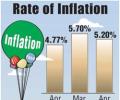
Food prices rose 8.64 per cent year-on-year last month, slower than an annual rise of 9.90 per cent in March.

Had you invested Rs 10,000 each in JSW Steel, Titan Company and Bajaj Finance 20 years ago, when they were just penny stocks (trading below Rs 10), you would have become a millionaire by now.

Retail inflation slowed to 4.29 per cent in April from 5.52 per cent in March, mainly due to easing food prices, government data showed on Wednesday. The Reserve Bank mainly factors in the retail inflation based on Consumer Price Index (CPI) while arriving at its monetary policy. As per the data released by Ministry of Statistics and Programme Implementation, inflation in the food basket was 2.02 per cent in April, down from 4.87 per cent in the preceding month.

The Reserve Bank's rate setting panel on Thursday met to finalise a report for the government on why it failed to keep retail inflation below the target of 6 per cent for three consecutive quarters since January this year, said sources. The report will be presented to the government as per the Reserve Bank of India Act, they added. The six-member Monetary Policy Committee (MPC) is headed by Governor Shaktikanta Das.

Last week, the Consumer Price Index-based inflation for the month had contracted to 4.4 per cent.

Potato, a daily consumable vegetable, witnessed maximum inflationary pressure at 60.58 per cent
Inflation in the 'fuel and power' basket in December slumped to 8.38 per cent, nearly half of 16.28 per cent.
Currently, the retail inflation is well below the RBI's comfort level. The government has asked the central bank to keep inflation in the range of 4 per cent.
Companies in the banking, finance sector and insurance (BFSI) sector have underperformed on the bourses despite leading the earnings growth charts in the post-pandemic period. This has created a dichotomy between their earnings and share prices. BFSI companies have never been less expensive than the rest of the equity market.

'Like every Budget, this time, too, there is chatter around tinkering with the long-term capital gains tax.' 'Investors may not want to jump into the markets until there is clarity on this front.'

Shares of Avenue Supermarts, which owns and operates the DMart stores, hit a two-year high of Rs 4,710.15 as they surged nearly 6 per cent on the BSE in Thursday's (April 4) intraday trade after reporting strong revenue growth in the January-March quarter (Q4) of the previous financial year (FY24). DMart, in the Q4FY24 pre-quarter update, said the company reported 20 per cent growth in standalone revenue from operations at Rs 12,393 crore, as against Rs 10,337 crore in the third quarter (Q3) of 2022-23 (FY23), driven by a 7 per cent growth in revenue per store and a robust 13 per cent year-on-year (Y-o-Y) increase in store additions. In Q3 of 2021-22, the company reported revenue of Rs 8,606 crore and in Q3 of 2020-21, it posted revenue of Rs 7,303 crore.

'As the markets are expected to remain jittery in the near term, we advise investors to use this opportunity to enter quality largecaps from a long-term perspective.'

Indian passenger vehicles market registered record wholesales of 43 lakh units in 2024, with companies like market leader Maruti Suzuki, Hyundai, Tata Motors, Toyota Kirloskar Motor, and Kia posting their best-ever annual domestic sales. The continued growth of SUVs, along with rural markets playing a key role in driving up car sales, helped the industry better the previous best of nearly 41.1 lakh units posted in 2023.

India's manufacturing sector saw a slower growth rate for the second straight month in May but stayed firmly in expansion mode with global sales increasing to the greatest extent in over 13 years, a monthly survey said on Monday. The seasonally adjusted HSBC India Manufacturing Purchasing Managers' Index (PMI) fell from 58.8 in April to 57.5 in May, signalling a slower but substantial improvement in the health of the sector. The index had climbed to a 16-year high of 59.1 in March.

On overall basis, the inflation in the food segment increased to 4.42 per cent in November as compared to 1.9 per cent in the preceding month.

Be a disciplined investor for attractive returns, says fund managers.

Inflation in food articles inched up to 0.69 per cent in September.

Big, listed FMCG (fast-moving consumer goods) companies such as Hindustan Unilever, ITC, Nestl, and Britannia have been top-performing stocks on the bourses in recent weeks. The Nifty FMCG index, which tracks the share prices of the country's top 15 listed FMCG companies, is up 1.9 per cent month-to-date in May compared to a 2.4 per cent decline in the benchmark Nifty 50 in the period.

Prices of the kitchen staple in Azadpur mandi, Asia's largest wholesale market, were ruling at Rs 60 per kg today as supplies were below normal.

This is the case even though the benchmark index is only 5 per cent below its all-time high. The list of stocks trading at a discount primarily consists companies in the automotive, banking, oil and gas, insurance, healthcare, and metal sectors.

Retail inflation in pulses and products category rose to a staggering 42.20 per cent in October.

Now that the economy is growing at a higher-than-expected rate, it is time to accelerate the pace of fiscal consolidation, and the Budget could be a good starting point, argues Rajesh Kumar.

This growth seen by the consumer goods was led mainly by the durables market, which rose 17.6%, the highest in 11 months

Soft crude prices will cut fuel subsidy bill and help contain fiscal slippage this year.
